"Send me the product proposal so I can share it with the team."
Aren't those the words you want to hear after a good conversation with an investor, a leadership team, or a potential partner? In many ways, it signals that you have a product idea worth backing. It gets tricky when you need to put something on paper that does what you did in that room, without you being there to present it.
Maybe you don't know where to begin. Maybe your instinct is to put everything in (think every feature, every use case, every detail) just in case. Or maybe you're so close to the idea that you misjudge what the stakeholders actually need to hear vs what you're excited to say. All of it is normal. All of it will cost you.
Writing a product proposal is hard even for the most seasoned product pros, and we've got the data to back that up. What it shows is that a proposal rarely fails because the idea is weak. It almost always comes down to whether the document was built for the reader, not the writer.
So if you've ever spent hours on a product proposal that still didn't feel quite right, or watched a solid idea get rejected without a real explanation, this is for you. We're breaking down exactly what goes into a product proposal that does the selling for you, even when you're not in the room.
Let’s dive in!
Key takeaways
- Product proposals are essential for presenting ideas and outlining problems, solutions, and benefits to gain stakeholder support.
- Proposals vary by audience (e.g., B2B, B2C, investors) and must be tailored to specific needs.
- A title page, executive summary, problem, solution, implementation plan, financials, and a call to action are crucial features in a proposal.
- You can know your audience, define the problem, focus on benefits, and polish the document using tools like Qwilr for efficiency.
Product proposal vs business proposal vs sales proposal: What's the difference?
A product proposal is a document that makes the case for a product idea to secure investment, internal approval, funding, or a partnership.
If you're here, you probably already know that. But talking to founders, PMs, and sellers, what becomes clear pretty quickly is that the definition gets murkier the moment you sit down to write one. Is it the same as a business proposal? A sales proposal? Does the format change depending on who's reading it?
It does. Here's the simplest way to think about it.
Take Flowly, a hypothetical HR tech platform that helps companies hire faster, onboard smoother, and keep their people ops from falling through the cracks. Depending on the situation, Flowly would reach for a completely different document.
| Document | What it's for | Key difference | Example |
|---|---|---|---|
Product proposal | Making the case for a product idea that needs commitment behind it | The product needs belief and resources behind it, from an investor, a leadership team, a collaborator, or a potential partner | Flowly's founder pitches to a VC for funding, a CPO presents a new product feature to the leadership team for budget approval, or a PM makes the case to a potential integration partner for a joint build |
Business proposal | Presenting a company and why someone should work with them | Broad, relationship-focused, commercial | Flowly proposes a partnership to an enterprise HRIS platform, outlining how an integration would create mutual value for both customer bases |
Sales proposal | Selling an existing product to a ready buyer | The decision is transactional as the product exists, the buyer is evaluating it | Flowly's AE sends a tailored proposal to a fast-growing tech company that attended a demo and is now comparing vendors |
A product proposal sits in a different lane from both. The reader could be a VC weighing a funding decision, a CFO evaluating a budget request, a leadership team deciding whether to greenlight a new product, or a potential collaborator figuring out whether to build something with you.
In every case, they're being asked to put resources, budget, or their name behind something that still needs their commitment to move forward. That's a different kind of ask. And it needs a different kind of document.
3 Product proposal types: Which one are you writing?
When most people think of a product proposal, they imagine a single format, i.e., a document you send when you need someone to say yes to something. But as we established, a product proposal is specifically about getting commitment behind a product idea. And depending on who you need that commitment from, the type of proposal you write changes significantly.
In practice, there are really only three.
1. Internal product proposal
This is the proposal that lives closest to home. You have a product idea for a new feature, a new tool, or a new direction, and you need your own organization to back it. That means budget, headcount, or a green light from leadership before anything moves forward.
But if you've ever written one that got shelved after a single review meeting with no real explanation, you already know what you're up against.
The numbers tell a pretty honest story. In one product team's experience, only 34% of product proposals were accepted, and just 22% were actually implemented. Nearly half sat in review or on hold indefinitely. Not because the ideas were bad, but because the proposals didn't make the business case clear enough for the people holding the purse strings.
The internal product proposal has one job, and that’s to make it easy for leadership to say yes. That means speaking their language in terms of ROI, resource requirements, strategic fit, timeline— not yours. The proposal that gets approved is rarely the most detailed one. It's the one that answers the right questions for the right audience.
2. Partnership product proposal
A partnership product proposal is what you write when you want to build, distribute, or go to market with another company. The ask is not funding or internal approval, but mostly alignment. That’s why you need them to see the mutual upside clearly enough to commit time, resources, and their name to building something together.
What makes this type of proposal particularly tricky is that it has to work for someone who is also evaluating what they stand to gain, not just what you're offering. A proposal that leads with your product vision and your goals will stall. One that leads with what the partner gets out of it will move.
Umberto Anderle, Co-founder at HowdyGo, captures the mindset well:
"We try to keep proposals as simple as possible. I feel like you should be able to quickly understand a proposal from a single page and not have to read through an endless PDF to catch the main points."
In a partnership context, that simplicity is even more critical as the person reading your proposal is busy, probably fielding other partnership conversations, and making a judgment call on whether the juice is worth the squeeze. Your proposal needs to answer that question fast and make the mutual value impossible to miss.
3. Client-specific product proposal
A client-specific product proposal makes the case for a product solution shaped around one client's exact situation, such as their challenges, their goals, and their language, for an audience that extends well beyond the person you originally pitched to.
The product exists. But the proposal is doing the work of showing precisely how it fits their world, for everyone who will ever read it. That requires a level of specificity and forwardability that a standard proposal rarely achieves.
Gianpiero Lanza, at Cloud Assess, puts it directly:
"I always start by getting to know the client's business and industry inside out. This helps me figure out their specific challenges and goals, whether it's driving more leads for a B2B company or boosting sales for an e-commerce store. Then, I put together a plan that directly addresses those needs. It's not about offering a cookie-cutter solution — it's about being super relevant to them."
That relevance has to survive the forward. When your contact shares the proposal with their CFO or their operations lead, those people need to feel the same specificity. If the proposal could have been written for anyone, it would convince no one.
Building your product proposal: What to include and how to make each section count
A lot of product proposals fail not because the idea is wrong but because the document is incomplete, inconsistent, or built around the wrong priorities. Knowing what to include and what each section needs to do is the difference between a proposal that moves a decision forward and one that sits in someone's inbox waiting for a follow-up that never comes (and you don’t want that!)
A strong product proposal should have the following components:
- Title page
- Executive summary
- Problem statement
- Solution
- Implementation plan
- Financials
- Social proof and credibility
- Conclusion and next steps
- Appendices
We've mapped all of these into a ready-to-use product proposal template, but before you grab it, it's worth understanding what each section actually needs to do.
Title page
Your title page sets the tone for your proposal (and if you didn't know already, you're aiming for professional, confident, and persuasive). Name the proposal clearly, say who it's from, and make it look polished enough that the reader feels confident before they've read a word.
Think of it as the cover of a book. If it looks like it was thrown together in a hurry, the reader will assume the rest was too.
That's why it's worth spending a few minutes getting the presentation right — and with Qwilr's editor, you can match your brand colors, logo, and fonts in a few clicks, so your proposal shows up looking like it came from a company worth backing, not a Google Doc someone formatted at midnight.
Executive summary
The executive summary is a brief overview of the problem, solution, and value. It's your quick sell in written form. Keep it concise but impactful, as many decision-makers may only read this section, so it needs to stand completely on its own.
We also recommend writing it last, after you've completed the rest of the proposal. By then, you know exactly what the argument is and what the ask is. Three to five sentences: problem, solution, outcome, ask.
Ben Child at Digital Reach puts it plainly:
"We treat our proposals like decks now — something our champion can forward to finance or legal without needing us to re-explain everything. It does the selling for us."
That's the standard to aim for. And since this is the section most likely to get forwarded to someone who wasn't in the original conversation, it pays to make sure it looks as good as it reads. Again, Qwilr's editor also lets you structure and style your executive summary so it's clean, scannable, and on-brand, without any formatting.
Problem statement
Clearly define the issue your product addresses. Use data, anecdotes, and real-world examples to illustrate the problem and its impact on your audience. The sharpest problem statements make the reader feel seen before they've read the solution. It makes sense, therefore, to use the words that came up in your conversations, your research, and your discovery process. If the reader gets to your solution section and thinks, "Yes, that's exactly the problem," your problem statement did its job.
As Umberto shared with us before,
"Personalization... it's about whether the proposal solves the pain points uncovered during the discovery process. Does it use the customer's language and terminology... or is it copy/pasted from a template?"
That level of specificity doesn't happen by accident. It comes from doing the work before you write a single word, and making sure what you learned in those conversations shows up on the page.
Solution
Once you've identified the problem, describe your product and its benefits. Explain how it solves the problem and creates value. Avoid technical jargon unless your audience is highly technical; the goal is clarity, not complexity.
Lead with benefits, not features. Tie every capability you mention to a specific outcome your reader cares about and keep it to three key points maximum. If it needs more than that, the solution section is doing the appendix's job, and you've lost the thread.
Implementation plan
Stakeholders, whether they're investors, leadership, or potential partners, want to see that you've thought past the idea.
Break the plan into clear phases, such as "Phase 1: Onboarding and Training," and include specific dates or timeframes for each phase. If there's a milestone your stakeholder named, such as a board meeting, a funding round close, or a product launch window, mirror it here to signal that you were listening and that you've built the plan around their reality, not a generic template.
Vagueness here is where decisions stall. The more specific you are about what happens after yes, the easier it is for the reader to say it. For a practical framework on building this out, here's how to create an implementation plan.
Financials
When it comes to financials, provide pricing, cost breakdowns, and ROI estimates, and be as transparent and detailed as possible, especially for investor and funding contexts where the numbers are often the deciding factor.
The problem with most financial sections is that they're static. The reader has a question, they can't answer it themselves, and suddenly, your proposal is waiting on an email thread. Qwilr fixes that. The interactive quote blocks and ROI calculator let stakeholders play with the numbers directly in the document, allowing them to model scenarios, adjust scope, stress-test the budget, even before they ever need to loop someone else in.
Not to forget that proposals with interactive elements convert up to 2x higher.
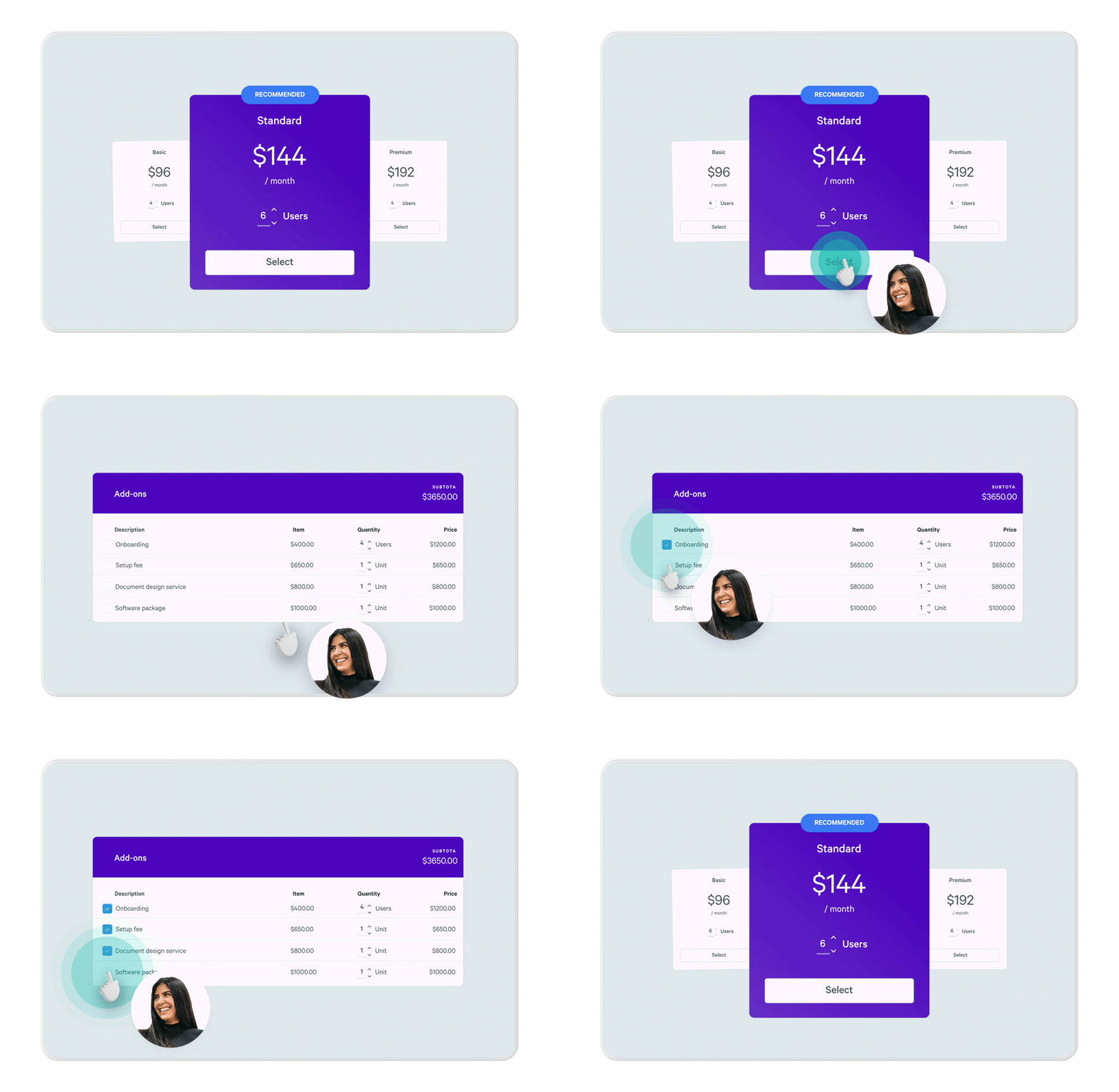
In partnership and B2B contexts, QwilrPay enables stakeholders to pay directly within the proposal, without any friction.
Social proof and credibility
Social proof doesn’t always appear in most product proposal templates, but it should. It’s because one proof point placed near the financials does more work than anything else in the document. For investor proposals, that's a traction metric or early customer quote. For internal proposals, it's a reference to a comparable initiative that worked. For partnership proposals, it's a signal that others have already backed you.
Conclusion and next steps
This is the most obvious step and one where your audience should finish this section knowing exactly what they're committing to and what happens the moment they say yes. For investor and funding contexts, name the ask clearly in terms of the amount, the timeline, and the next conversation you're requesting.
If you confirmed any urgency earlier in the process, such as a board date, a funding deadline, or a launch window, use it here. In partnership and B2B contexts, this is where Qwilr's integrated e-signature shines. Instead of sending a separate agreement and waiting for it to come back, stakeholders can commit directly in the document.
Sydney Youngblood, Senior Account Executive, adds one more move worth considering:
"I like using opt-out periods to reduce the risk of every customer's fear — shelfware. It addresses the hesitation before it becomes an objection."
Lowering the perceived risk of saying yes is often the last thing standing between a good proposal and a signed one.
Appendices
And finally, add supplementary materials that support your main argument without cluttering the core content such as technical specs, team bios, FAQs, and research data. The best part about this section is that it lets you go deep without making the reader wade through details they didn't ask for.
In Qwilr, appendix-style content lives in expandable blocks, so everything is accessible without breaking the flow of the proposal.
How to write a product proposal (step by step)
If you've made it here, you know what goes into a product proposal. Now let's talk about how to actually write one that lands.
Step 1: Know your decision-maker before you write a word
The proposals that get approved start by asking who is actually reading this and what they need to feel confident enough to commit.
Take, for example, a CEO you are pitching to; they’re likely more focused on strategic fit and long-term vision than line-item costs. An investor needs to see a credible market opportunity, and a potential partner needs to understand the mutual upside before they commit their team's time.
Knowing who your champion is, and who they need to convince above them, shapes everything from the opening line to the ask at the end. The document comes after that clarity, not before it.
"One that's often missed is proper pre-proposal alignment, too many teams rush to send a deck without confirming key details like appetite, authority, or timing."
Mael Hartl, Head of RevOps at Shippit
Step 2: Lead with the problem, not the product
It's a product proposal, so lead with the product, right? I mean, that's a no-brainer. Except it isn't, and this is where most product proposals lose the reader before they've even gotten to the good part.
The reader needs to feel that you understand their situation before they care about what you've built. Open your problem statement with something they already believe to be true. Deepen it. Then show that your product is the logical response and not the other way around.
Roman Pichler, product management expert and author of "How to Lead in Product Management," makes the stakes clear:
"The most amazing product strategy and the best product roadmap are worthless if the stakeholders don't support them."
Getting that support starts with making the reader feel the problem before you present the solution.
Step 3: Write the executive summary for the person who wasn't in the room
The way most people approach a product proposal is as if it will be read by one person— the one they pitched to. But the thing is, it won't be. And that's actually a good thing!
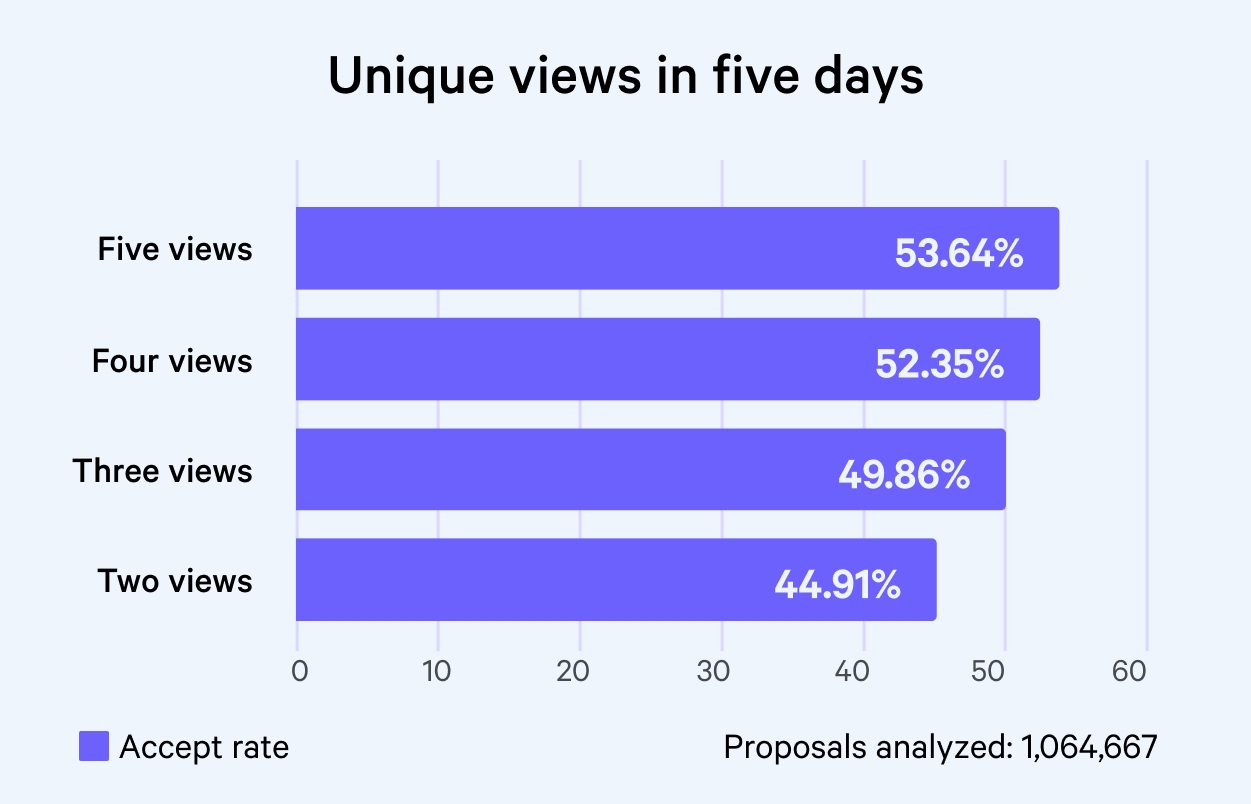
Most people think "ugh, so many decision-makers" when they realize their proposal is going to be forwarded up the chain. But every additional person who reads it is another shot at a yes. Our research across more than a million proposals found that proposals shared with two or more additional stakeholders within five days are nearly twice as likely to be accepted.
Step 4: Nail the golden content block rule
How many content blocks should you have on your proposal? Is it nine? Is ten too many? The golden number is six, as found in our analysis of over a million proposals. Proposals with fewer than six content blocks had a 66% higher conversion rate than longer ones.
The instinct to include everything ( every detail, every use case, every qualifier) actually works against you.
The people closing deals already know this. Dara Fitzpatrick, Director of Sales at Forefront Events, says it plainly: "Gone are the days of lengthy proposals; everyone wants short and sharp and compelling."
Mael Hartl at Shippit agrees:
"Dense 50-page decks are out." And Umberto Anderle, Co-founder at HowdyGo, puts the bar simply: "You should be able to quickly understand a proposal from a single page."
Step 5: Track it, because the decision is still happening after you send it
And finally, something no one tells you (but we will).
Most people send a proposal and think something magical would make the prospect come back to them! A lot of it is due to the fact that there’s zero visibility after they hit send. The ones who close more deals know exactly when to follow up, not by guessing, but by seeing when the proposal is actively under review.
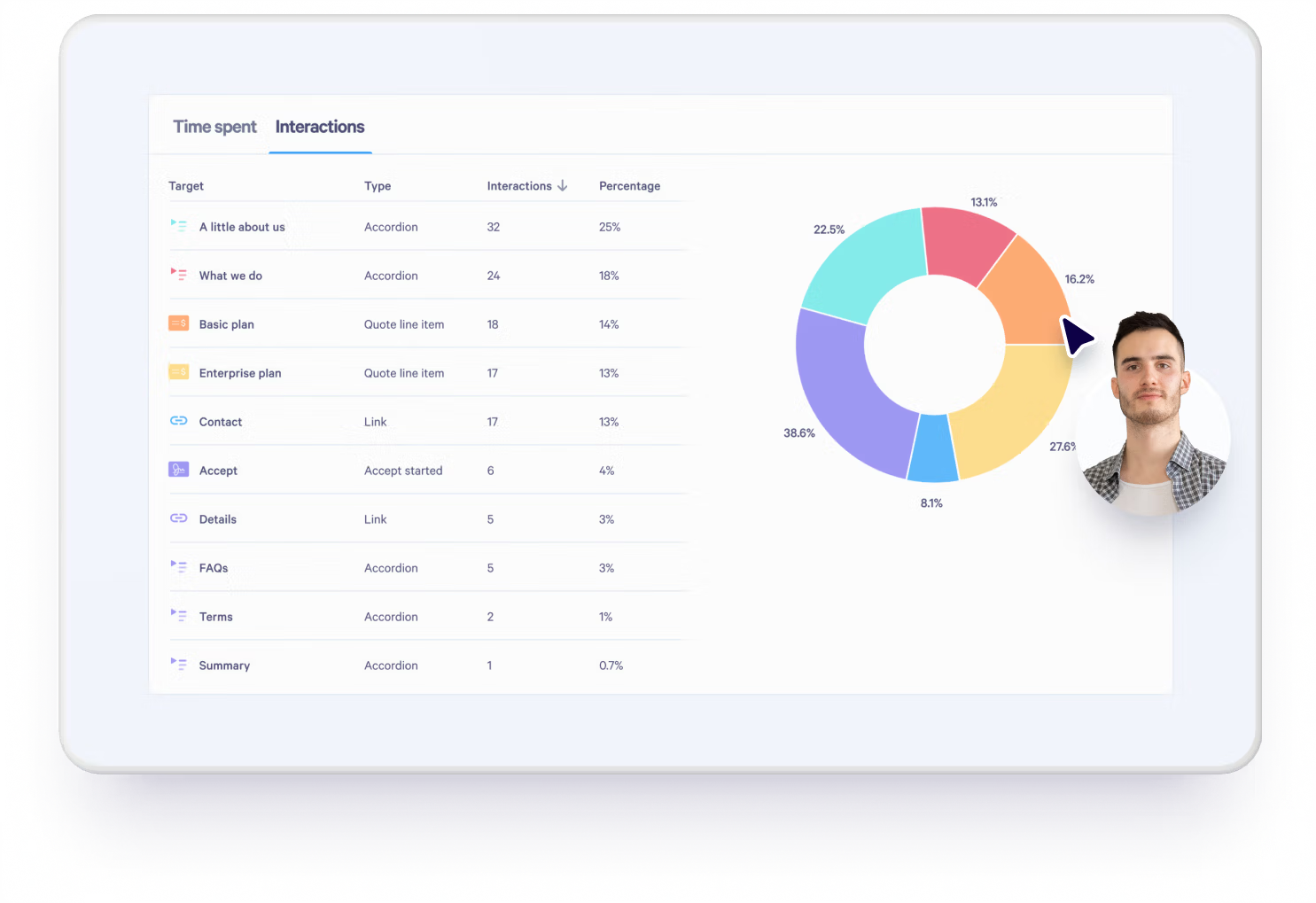
And this is where having the right tool makes all the difference. Qwilr's analytics and real-time notifications show you who has opened the proposal, which sections they spent time on, and when it has been shared internally. So instead of a "just checking in" email into the void, you're reaching out at exactly the right moment.
The data makes the case: proposals viewed for more than four minutes had an acceptance rate of 41%. Those viewed for under a minute: 3.5%. That's an 11x difference, and it has everything to do with knowing when your buyer is engaged and acting on it.
Locking it in with Qwilr
Having read this far, you now know what a product proposal needs to do, what goes in it, and how to write one that works when you're not in the room to present it. The hard part is knowing. The next part is doing.
Qwilr's product proposal template has all the right sections built in, so you're not starting from scratch. And our product has everything you need to move the deal forward with interactive pricing, ROI calculators, embedded video, e-sign, and real-time analytics that tell you exactly when your proposal is being read.
And if you want a hand getting set up, book a demo, and our friendly team will walk you through it.
About the author

Taru Bhargava|Content Strategist & Marketer
Taru is a content strategist and marketer with over 15 years of experience working with global startups, scale-ups, and agencies. Through taru&co., she combines her expert skills in content strategy, brand management, and SEO to drive more high-intent organic traffic for ambitious brands. When she’s not working, she’s busy raising two tiny dragons. She's on a first-name basis with Mindy Kaling.