Search has changed more in the last two years than in the previous decade.
According to HubSpot, 41% of marketers now list updating their SEO strategy as the top trend they're actively exploring. It’s a direct response to AI-generated answers, LLM referral traffic, and answer engine optimization displacing traditional organic clicks from major search engines.
For enterprise teams, that shift makes the SEO proposal harder to write and easier to get wrong. SEO agencies and in-house experts evaluating organic search against paid acquisition costs need evidence that their efforts hold ground as AI reshapes how buyers find information.
This guide covers the key components every enterprise SEO proposal needs, a step-by-step process for building one, and practical advice on improving close rates once the proposal is written.
What is an SEO proposal?
An SEO proposal is a formal document that outlines a proposed search engine optimization strategy, defines measurable business outcomes, and presents the scope, timeline, and investment required to execute it.
Enterprise SEO directors, digital marketing leaders, and agency teams use proposals to secure budget approval and align multiple stakeholders, including CMOs, CFOs, and IT leadership, around a single organic growth strategy.
An effective SEO proposal maps search engine visibility to pipeline contribution, customer acquisition costs, and revenue growth across markets or product lines. It gives potential clients a clear picture of what search engine optimization delivers commercially.
Key components of an SEO proposal
Enterprise proposals differ from SMB engagements in one critical way: the document has to resolve the concerns of five to eight decision-makers simultaneously. Each component frames the proposal through a different lens, such as technical feasibility, budget justification, implementation risk, and strategic fit.
Ben Major, Director of Organic Growth Strategy and SEO expert sums it up nicely:
Simply put, the proposal should directly address the client’s needs and can be distilled down into the following format - what is the size of the prize? - how much is it going to cost to get there? - and how long is it going to take?
The components below address that complexity directly. Understanding how to structure a proposal ensures these components flow logically.
Executive summary
The executive summary is a 200-400 word overview of the entire SEO proposal. Write it after every other section is complete. SEO directors who write it first lock themselves into a narrative before the audit data, competitive analysis, and pricing shape the actual recommendation.
For enterprise engagements, the executive summary carries more weight than in SMB proposals. Peripheral stakeholders — procurement leads, legal reviewers, finance directors — often make initial approval decisions based on the summary alone before the full proposal reaches the primary contact. A summary that reads like an SEO brief loses those reviewers before they ever open the strategy section.
Cover four things:
- Client's current SEO position
- Size of the organic opportunity
- Proposed approach
- Projected business outcome
Structure the summary so the CFO finds the ROI case in the first paragraph, the CMO finds the market opportunity in the second, and the technical lead finds the implementation approach in the third. Each reader should be able to stop reading after their section and still have enough information to form a preliminary view.
Current SEO performance audit
Before proposing a strategy, SEO teams need a documented baseline. The audit captures where the client's website stands across four areas: technical health, keyword rankings, content performance, and backlink profile.
Technical issues such as crawlability problems, broken links, page speed, and indexation errors belong in this section because they set the ceiling on what any content or link-building strategy can achieve.
Keep the audit findings specific and prioritized. Flag the three to five findings with the highest impact on search engine results and organic performance that underperform against competitors, and build the strategic recommendation around those.
For enterprise websites with thousands of indexed pages, define the audit scope upfront. A comprehensive crawl of a 50,000-page site produces a different set of findings than an SMB audit, and the proposal should signal that the team has a methodology for prioritizing issues at scale.
“I like to take a fully tailored approach, digging into the client's website with their ICP and goals in mind. I also like to understand the competitors that are on their mind and who they're really keen to beat - I compare them to and review these competitors (and others) for missed opportunities, identify areas from improvement on the client's site, and spend time coming up with creative strategic ideas to include at a high level. I make sure to tie every opportunity I add back to their specific context and KPIs. This is crucial for helping the potential client to feel understood and heard, and for them to see a clear link between what is being suggested and their specific goals.”
Alistair Pike, Growth Strategy Consultant
Competitor analysis
Organic search is a fixed pool of attention. When a competitor ranks for a high-intent keyword, the client doesn't. The competitor analysis makes that dynamic visible by mapping where rivals hold search engine rankings the client doesn't, which content formats dominate search results, and where backlink gaps are widest — including domain authority differences that affect how quickly new content can rank.
Internal stakeholders already know the site has SEO problems. What moves budget conversations forward is evidence of how much ground competitors are gaining and at what rate.
Pro tip: Enterprise organizations typically face a wider gap between direct competitors and organic competitors than SMB businesses do. A direct competitor may rank for ten of the same product keywords, but a media publisher, industry association, or adjacent SaaS company may be winning fifty informational queries that sit at the top of the enterprise buyer's research journey. Identifying both categories, two to four direct and two to four organic, surfaces the full scope of the ranking gap and gives the proposal a stronger commercial case for content investment.
SEO objectives and KPIs
SEO objectives define what success looks like at the end of the engagement.
Objectives that stop at organic traffic and ranking movements give finance and procurement stakeholders no basis for evaluating return on investment. Tie every objective to a business outcome such as lead generation, pipeline contribution, customer acquisition cost, or revenue from organic search.
Setting objectives before building the strategy keeps KPIs grounded in what the client is trying to achieve commercially.
Pair each objective with an SEO metric that makes progress measurable at regular intervals, and agree on reporting frequency with the client upfront so clear expectations are set before work begins:
- Revenue objective → organic-attributed pipeline or assisted conversions
- Visibility objective → share of voice across target keyword set
- Efficiency objective → organic CAC compared to paid channels
- Authority objective → domain authority and referring domain growth rate quarter-over-quarter
Be conservative with projections. SEO timelines are long, and search algorithms change, and specific ranking guarantees for specific keywords create expectations that no proposal should make.
Alistair Pike, Growth Strategy Consultant, explains:
“I like to understand the client's KPIs and real business objectives - first prize is getting it straight from them by asking. The second best is reviewing the site to get a sense of where they're leading visitors and what actions they're calling. This can give us a good idea of the top-level KPIs. If we don't get any specific goals from the client that we can work backward from, we can work forward from the search data we find. We can apply benchmark conversion rates to traffic figures to establish projections for various tactics. I also make sure to always tie the objectives back to revenue—the growth of which is the ultimate objective.”
Proposed strategy and scope of work
The strategy section translates audit findings and objectives into a concrete plan. It covers what work gets done, in what order, and why each initiative connects to the client's stated goals.
For enterprise engagements spanning large websites or multiple markets, sequencing determines which initiatives deliver early evidence of progress and which ones require longer lead times.
Avoid a generic list of SEO services. Trace every recommendation, whether technical SEO fixes, on-page optimization, link building, content creation, or keyword research, back to a specific finding in the initial audit or a gap identified in the competitor analysis.
Pro tip: Structure the scope around three to four strategic priorities. Trying to address every SEO activity at once makes it harder to understand where the engagement focuses first and what drives early search results.
"If you know the client lacks significant developer resources (and you've found no high-priority issues during your research), it's probably best to omit any technical insights from the proposal and focus on more tangible issues, especially if they were purposefully brought up during the initial discussion."
Ben Major
Deliverables and milestones
Deliverables define the tangible outputs the client receives at each stage of the engagement, while milestones mark the points at which those deliverables get reviewed and signed off.
Deliverables can include:
- Technical audit reports covering broken links, crawl errors, and page-level issues
- Keyword research and keyword strategy documentation
- Content briefs and content writing guidelines
- On page optimization and optimized page sets
- Link building targets, including guest posting and digital PR campaigns
- Reporting frequency schedule and performance reviews
A deliverable without a milestone attached gives the client no clear moment to evaluate progress or provide feedback. It creates ambiguity about whether the engagement is on track.
Structure deliverables in phases with key milestones rather than as a flat list. Phased delivery gives decision-makers visibility into how the SEO work builds over time and makes it easier to connect early outputs to the objectives established at the start of the engagement.
Client testimonials and case studies
Client testimonials and case studies give third-party evidence that the proposed strategy has produced results in comparable engagements.
Keep this section specific. A case study that names the client's industry, documents the starting position, and quantifies the outcome carries more weight than a generic endorsement.
Two to three targeted examples outperform a longer list of logos. Select case studies that match the prospective client's industry, company size, or the specific SEO challenge the proposal is addressing.
Implementation timeline
The timeline translates the phased delivery plan into a schedule. For enterprise SEO engagements, monthly blocks work better than week-by-week breakdowns. Trying to assign specific dates to deliverables months in advance creates unnecessary pressure and rarely reflects how complex projects actually progress.
Build two things into every timeline that most proposals omit: feedback windows and iteration cycles. Since legal, compliance, and multiple internal reviewers all add time between submission and sign-off, a timeline that doesn't account for that will slip within the first month.
Flag dependencies explicitly, such as if content creation relies on the client supplying brand guidelines or subject matter expert access or if keyword research requires sign-off before content writing begins. Those requirements belong in the implementation timeline so potential clients understand their role in keeping the engagement on schedule.
Schedule a documented sign-off that confirms deliverables are complete before the next phase begins.
Pricing and investment options
Pricing tables present SEO investment options in a structured format. Each tier defines the scope of SEO services — keyword research targets, content writing volume, link building activity, on-page optimization, and reporting frequency — alongside the projected outcomes at that level of investment.

Pricing tiers give a buying committee with different priorities a single reference point. The CFO sees the cost against the projected organic revenue contribution. Procurement sees scope boundaries. The SEO director sees what changes between tiers and what that means for the timeline and market coverage.
Enterprise SEO engagements often require pricing models that SMB proposals don't. Three structures worth presenting:
- Retainer with performance tiers: A base retainer covering core deliverables with additional investment reduces perceived risk for finance stakeholders approving multi-year budgets
- Hybrid model: A fixed project fee for the audit and strategy phase followed by a monthly retainer for execution
- Multi-market or multi-brand pricing: For organizations with multiple websites, regional domains, or product lines, present per-domain or per-market pricing
Qwilr's interactive pricing tables let potential clients select a tier, sign, and pay directly within the SEO proposal template.
It removes the back-and-forth that typically delays deals at the final stage, so the window between proposal submission and signed contract stays as short as possible.
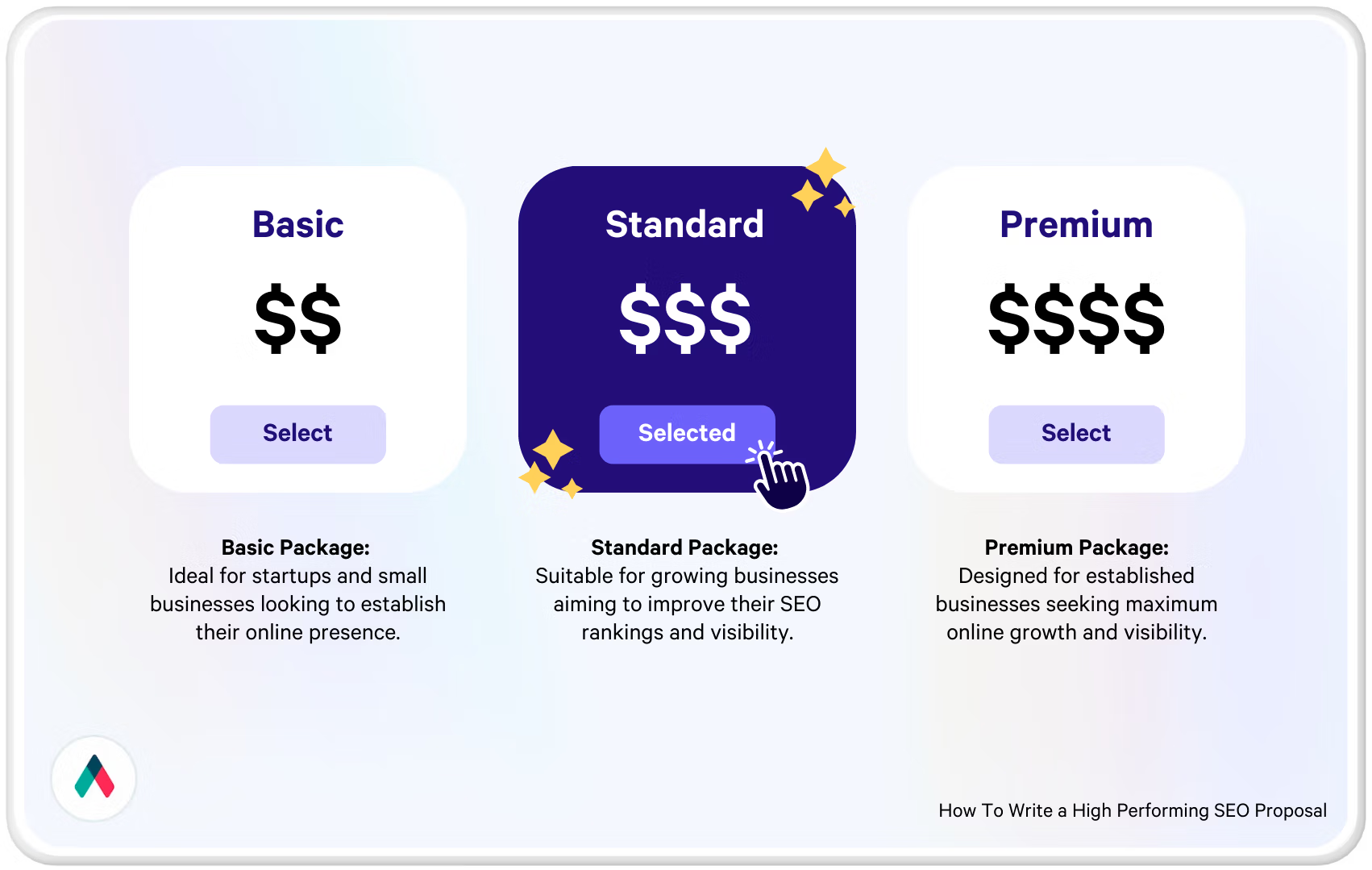
Include pricing breakdowns and the ability of clients to accept, sign, and pay—all within your Qwilr web-based proposal document
How to give your SEO proposal the best chance of winning
Enterprise sales involve multiple reviewers who weren't part of the discovery conversation with each one a potential point of friction between submission and sign-off.
Two friction points consistently stall enterprise SEO proposals: an objection raised by a stakeholder who wasn't in the discovery call, and administrative delays between verbal agreement and contract signature.
The steps below cover what SEO teams and agencies can do to improve close rates once the proposal is written.
Lead with the size of the opportunity
Enterprise buying committees evaluate SEO investment against a specific question: what does organic search contribute to revenue, and what does it cost to close the gap between current performance and where competitors are winning.
Lead with a documented opportunity such as:
- Competitor ranking gaps
- Organic traffic losses
- Revenue estimates tied to keyword opportunities
These give each decision-maker a concrete reason to keep reading and helps define deliverables in terms the client's business actually cares about.
Paul DeMott, Chief Technology Officer at Helium SEO, leads every proposal with this approach. Before writing a single deliverable, his team conducts a full technical audit and competitor keyword gap analysis so the prospect can see exactly where they’re losing ground before they reach the scope of work.
He says: "We gave them data illustrating they were losing approximately $40,000 per month in organic traffic value to five direct competitors. Each gap was identified by a specific piece of content or technical fix. The prospect signed a $12,000 monthly retainer two days after receiving our proposal. No additional contact was made."
Quantifying the opportunity in revenue terms before introducing any tactical SEO recommendation reframes the investment question, from whether search engine optimization is worth the cost to whether the cost of inaction is worth the risk.
Present the proposal in a live walkthrough
A proposal sent cold has to sell itself without context — there's no one available to address questions, frame the opportunity, or control how the document gets sequenced across a buying group.
Walking through the proposal live gives the SEO team control over that framing. Gabriel Bertolo, Founder and Creative Director at Radiant Elephant, makes a live or Zoom walkthrough a standard part of every proposal process.
"I set up an in-person or Zoom meeting, and we go through the proposal together. By implementing this process and proposal structure, our close rate has increased by 20%. Clients often tell us that the level of thought and depth we put into our proposal far surpassed the other companies."
For SEO agencies working with geographically distributed buying groups, an embedded async video walkthrough serves the same function. Every stakeholder gets the same context regardless of whether they attended the meeting, adding a personal touch that a cold document send cannot replicate.
Use AI to generate a first draft and customize from there
The sections of an SEO proposal that take the longest to write (like the scope of work) follow a consistent architecture across most engagements. The thinking that makes a proposal specific to a client sits in the audit findings, the competitive analysis, and the revenue projections.
Qwilr's AI proposal generator reduces proposal creation time by producing a structured SEO proposal draft in minutes.
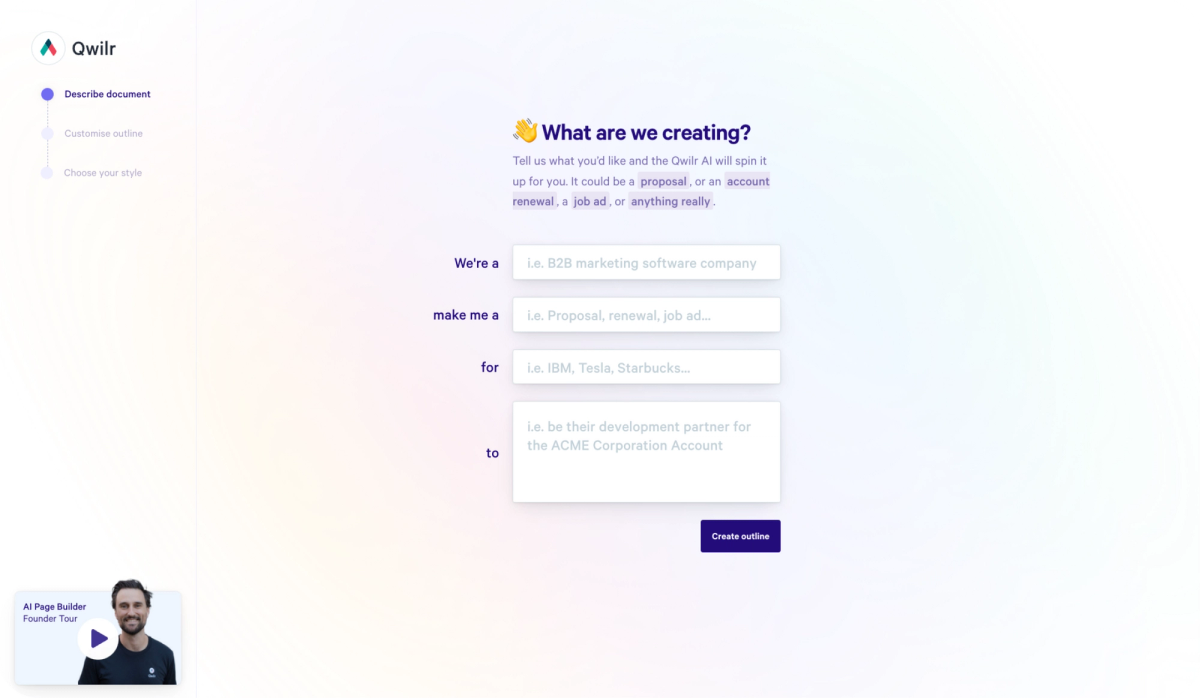
SEO experts get a professional foundation they can tailor to each engagement without rebuilding the document architecture from scratch.
The output isn't the finished proposal, but a starting point that compresses the time between discovery call and delivery, leaving more room for the customization.
Include a 90-day roadmap to reduce timeline skepticism
Organic search takes time to produce measurable results. A proposal that acknowledges this without showing exactly what happens in the intervening months gives stakeholders little to anchor their confidence to.
A 90-day roadmap addresses that directly. Break the first three months into specific phases, like:
- Technical SEO fixes and broken links in month one
- Content writing and on page optimization in month two
- Early performance review and reporting frequency confirmation in month three
Nassira Sennoune, founder of Rhillane Marketing Digital, attributes a €42k contract win directly to this approach.
"What made the difference was a clear quarterly roadmap, revenue-driven projections instead of vanity metrics, and precise deliverables. We projected +35% traffic and +18% revenue in six months, which led to a deal closed in 48 hours and a €42k annual contract, while two competitors were rejected."
A phased roadmap also sets the foundation for expectation alignment before work begins. Stakeholders know what gets delivered, when they review it, and what success looks like at each stage.
Embed supporting assets directly in the proposal
Audit reports, competitor analyses, and performance data sent as separate attachments get reviewed out of context — or not reviewed at all. When supporting evidence lives outside the proposal document, stakeholders evaluating the business case have to piece together the argument themselves.
Embedding assets directly inside the proposal keeps every data point in context, so the reviewer doesn't have to cross-reference separate files to follow the logic.
Supporting assets worth embedding include:
- Crawl audit reports showing technical SEO issue severity and page-level impact
- Competitor analysis and ranking comparisons mapped against the client's current keyword research
- Organic traffic projection models tied to specific keyword opportunities
- Google Data Studio or Looker Studio dashboards showing current search engine performance and SEO metrics
- Loom video walkthroughs of initial audit findings for decision-makers who weren't in the discovery call
Qwilr's proposal software lets SEO teams simply upload and embed all of the above directly into the SEO proposal template.
Every stakeholder gets a single, self-contained reference that presents the full picture without requiring them to open anything else.
Keep the proposal focused
Proposal length is not a signal of expertise. According to Qwilr's analysis of one million proposals, proposals six pages or less have a 66% higher acceptance rate and improved sales win rate.
Every section that doesn't advance the buying decision adds friction. Like an appendix of supporting data the client didn't ask for, a credentials section that runs three pages, or existing content reproduced in full when a summary would serve the same purpose. Each one asks the reviewer to do more work before reaching the information that matters.
Kelsie Tune, SEO Team Manager at The MTM Agency puts it directly: "Clients invest in SEO because they want more sales and growth — if that connection isn't obvious within the first few paragraphs, you've already lost the room."
Review the final SEO proposal with a single question for each section: does this give a stakeholder a specific reason to move forward? If the answer is no, cut it. Success stories and social proof earn their place, but generic capability statements about SEO services don't.
Track who has reviewed the proposal before reaching out
Following up before a key stakeholder has reviewed the proposal wastes the conversation. Reaching out too early means addressing questions the reviewer hasn't formed yet. Too late, though, and the momentum from a strong proposal has already faded.
Knowing exactly who has opened the document, which sections they spent time on, and whether the pricing page has been reviewed gives the SEO team the context to follow up with a relevant opening.
A CFO who spent four minutes on the pricing section and skipped the SEO strategy pages is signaling a different conversation than an SEO director who read the competitor analysis twice and didn't reach pricing at all.
Qwilr's sales content analytics surfaces individual stakeholder engagement across every section of the SEO proposal.
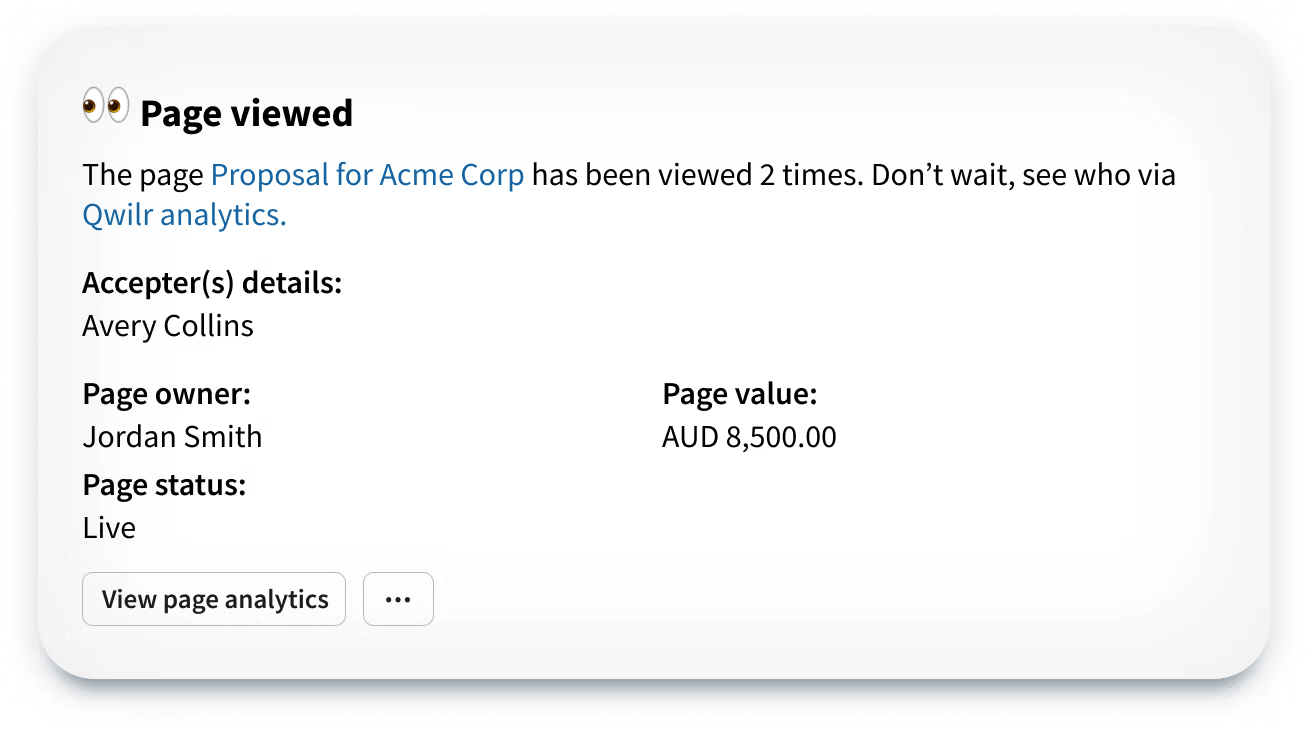
SEO experts get a precise picture of where interest is highest before they reach out to new clients or existing long term clients approaching renewal.
Free SEO proposal template
Qwilr's proposal template provides a structured starting point for SEO agencies and in-house SEO experts building a client-ready proposal. The template covers seven sections with each one designed to define deliverables clearly without requiring a follow-up conversation to fill in gaps.
The template is fully customizable within Qwilr. Tailor sections to each prospective client's industry and business goals, embed assets directly, and clients can accept, sign, and pay without leaving the document. For SEO agencies managing ongoing optimization across multiple SEO clients, saved blocks let teams reuse approved content across proposals while keeping the client-specific sections tailored to each working relationship.
Create outstanding SEO proposals with Qwilr
A strong SEO proposal covers the full picture: a documented baseline, a competitive opportunity, revenue-tied objectives, a tailored strategy, and pricing that connects investment to projected outcomes. It’s structured in a way that every stakeholder in the buying group finds what they need.
Qwilr's template provides that structure out of the box. Embed audit data and competitor analyses directly in the document, present interactive pricing tiers, and collect signatures and payment without leaving the proposal.
Get started with Qwilr's SEO proposal template today.
About the author

Kiran Shahid|Content Marketing Strategist
Kiran is a content marketing strategist with over nine years of experience creating research-driven content for B2B SaaS companies like HubSpot, Sprout Social, and Zapier. Her expertise in SEO, in-depth research, and data analysis allow her to create thought leadership for topics like AI, sales, productivity, content marketing, and ecommerce. When not writing, you can find her trying new foods and booking her next travel adventure."
FAQs
The best format for an SEO proposal is clear and simple. It should lay out the strategy, scope, timeline, and cost in an easy-to-understand and engaging way so the client can follow your plan and recognize the value of your proposal.
A free SEO proposal template can be a good starting point, especially if you're new to creating such documents. It provides a structured framework that ensures you cover all the critical aspects. Make sure you tailor it to your client's needs for a more personal touch.